Architecture overview
Status: Draft; implementation checked against the development source on 2026-09-08.
This page explains how genro-asgi is put together and the principles behind it.
It is explanation, not a how-to: read it to understand why the pieces are
shaped the way they are. The normative source is
SPECIFICATION.md
(the decision log, D1…); this page summarizes it and never contradicts it.
Core principles
These are the guiding principles of the redesign (SPECIFICATION.md §1). They explain most of the design decisions you will meet in the code.
No globals. The server is an instance with its own state — no module-level variables, no singletons. Use the lifespan shutdown to release resources; deleting a reference does not replace stopping active tasks, threads or child processes. State lives in objects, connected by semantic parent references.
Config is data, not structure. What a server is comes from a configuration recipe rendered onto it; the code shape does not change with the deployment.
Objects always exist; backends come from config. There is no
X | Noneattribute flipped on by a flag. The session store, the auth core, the task manager are always there — their backend is what configuration selects.Work at the time of use. Expensive machinery (the thread pool, the task manager) is provisioned lazily, on first use.
Routes are static from boot. The routing tree is built once; routing is never used as a mutable registry.
Extension by subclassing; capabilities as mixins. You add behaviour by subclassing an application, and the server composes capabilities (auth, session, tasks…) as mixins over a base.
The request flow
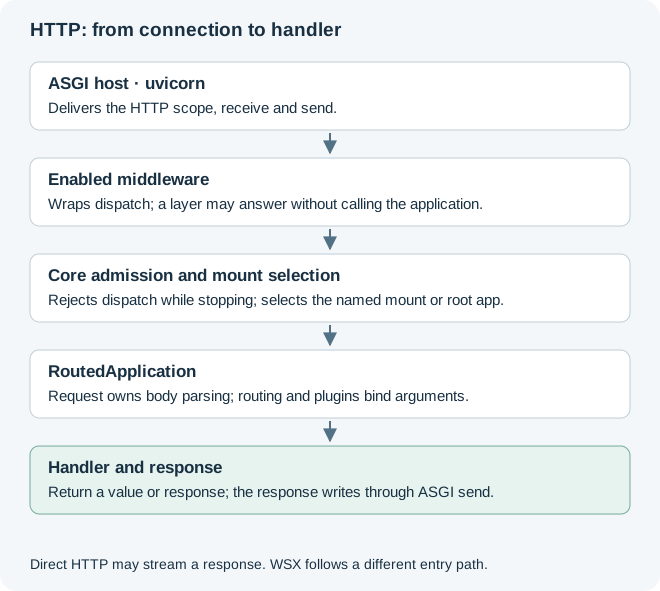
The response returns through ASGI send. Middleware may answer before core dispatch.
uvicorn
  → AsgiServer                      the server IS the ASGI app
    → middleware chain              errors → wellknown → logging → cors → session → auth
      → demultiplex                 first path segment → mount, else root app
        → application               a RoutedApplication (or a subclass)
          → @route handler(**params)
            → Response              buffered, or a StreamingResponse
              → ASGI send
Each middleware class declares numeric middleware_order; the chain sorts by
it, lowest outermost. The registry enables errors by default; AsgiServer also arms session
and auth through its mixins, even without explicit credential/store kwargs.
The two layers: server and application
genro-asgi separates what the server owns from what an application does.
BaseServer
BaseServer is the common substrate of every server (SPECIFICATION.md §4, D2).
It owns: one uvicorn loop, one monitored thread pool for blocking work, the
applications it was composed with (a dict keyed by each app’s code, plus
an index by mount — the URL prefix each one answers under, "" being the site
root), the lifespan (ordered startup/shutdown), and the request registry. At the
base, authenticate() and session() answer “nobody / none” — auth and sessions
are capabilities layered on top, not built into the base.
The one dispatch rule (D3) is: first path segment → the app mounted there;
else the app on the site root; else, for / with a default declared, a 307 to
it; else 404. A single-app server is just a base server whose only app sits on
the root — there is no separate mechanism.
AsgiServer
AsgiServer is the shipped composition (D22): it stacks every capability mixin
over BaseServer in one MRO — communication, auth, session, middleware,
plugins, storage, tasks. This is the complete mono-process async server. You
configure a capability through a constructor kwarg (auth=…, middleware=…,
tasks=…, plugins=…); the mixin peels the kwargs it understands and forwards
the rest down the cooperative __init__ chain.
Because auth is a mixin and not part of the base, an internal (non-public)
server can compose the same base without the auth mixin — its auth and
sessions are None by design, and whoever fronts it owns them (D1, D6).
BaseApplication and RoutedApplication
BaseApplication is the app-side contract: an ASGI callable with a code (its
identity), a mount (the URL prefix it answers under) and a server reference
assigned once by the owning server at attach time (a second assignment raises).
RoutedApplication wires
genro-routes into it: handlers are
@route-decorated methods, resolved through the app’s own router. The
OpenApiApplication, McpApplication and McpOpenApiApplication subclasses add
protocol faces (OpenAPI/Swagger, MCP) over the same route tree — which is why
one decorated method can serve REST and MCP at once.
The automatic _server application
Every AsgiServer auto-mounts a ServerApplication at /_server (D4). It
exposes the server’s own management surface — login, users, tokens, tasks —
under /_server/…, and its OpenAPI schema at /_server/_meta/schema_json. It
is automatic, not configured: a hand-built server has it exactly like one
built from a configuration (AsgiServer(config=…)).
Configuration: the server reads its own
A configuration is a recipe — a subclass of AsgiConfigBuilder whose main
opens the configuration root and delegates each section to its own method —
and the server builds its own read door over it:
from genro_asgi import AsgiServer
from genro_asgi.config import AsgiConfigBuilder

class ServerConfiguration(AsgiConfigBuilder):
    def main(self, root):
        cfg = root.configuration()
        cfg.server(host="127.0.0.1", port=8000)

server = AsgiServer(config=ServerConfiguration)
AsgiServer(config=…) accepts a recipe class, a recipe instance, a path to a
config.py, or a ready configuration handler (see the
configuration API). The handler is exposed as
server.config and is callable by path — server.config("server.host") —
over a four-layer read stack: the written value, the element signature’s
default, the call-site default=, then a noisy KeyError. Explicit
constructor kwargs win over configured ones, per kwarg.
Values that come from outside the recipe are resolvers in place: you store a
genro_bag.resolvers.EnvResolver where the value would go and it resolves at
read time, so the runtime always consumes the environment’s current value. An
application reads its own subtree through app.config(path), which prefixes
applications.<code>. and delegates to the same door — an app holds an address
in the tree, never a slice of it.
The how-to — writing the recipe, the resolvers, the read stack, an application’s own grammar — is the Configuration guide.
WebSockets and the multiworker package
The core implements WSX and raw WebSocket hosting. WSX messages enter the application through a synthetic HTTP scope, using the same routing and cleanup logic; they bypass the HTTP middleware chain.
The separate top-level package genro_asgi_multiworker_spa supplies the SPA front,
commander, worker processes and hosted ASGI/WSGI adapters. It ships in this same
distribution. Importing genro_asgi does not import that package. A hosted worker
request and response are buffered; this path is distinct from the core’s direct
HTTP streaming. See Multiworker SPA.
Application hooks and the server’s admission state are described in Lifecycle.
Where to go next
Getting started — install and run.
Concepts — the model in more practical terms.
SPECIFICATION.md— the full decision log.