Configuration
Status: Draft; implementation checked against the development source on 2026-09-08.
What it does
A configuration is a recipe: a Python class that writes down what the site is — the listener, the middleware, the identity surface, the applications — and a server built from it reads its own values back by path. There is no config file format to learn: the recipe is code, checked by a grammar that knows which elements exist and which attributes each one takes.
When to use it
Use a recipe as soon as the server is more than a demo: it is the one place a
deployment differs, and genro-asgi serve ./config.py turns it into a complete
deployment unit (see the genro-asgi command). Keep building the
server by hand — AsgiServer(applications=[...]) — for a test, a script, or an
embedded server whose objects the recipe cannot express.
Setup
Nothing to install. genro_asgi.config ships AsgiConfigBuilder (the dialect
you subclass) and ConfigurationHandler (the read door the server builds for
itself); AsgiServer.grammar is the grammar they validate against.
At a glance
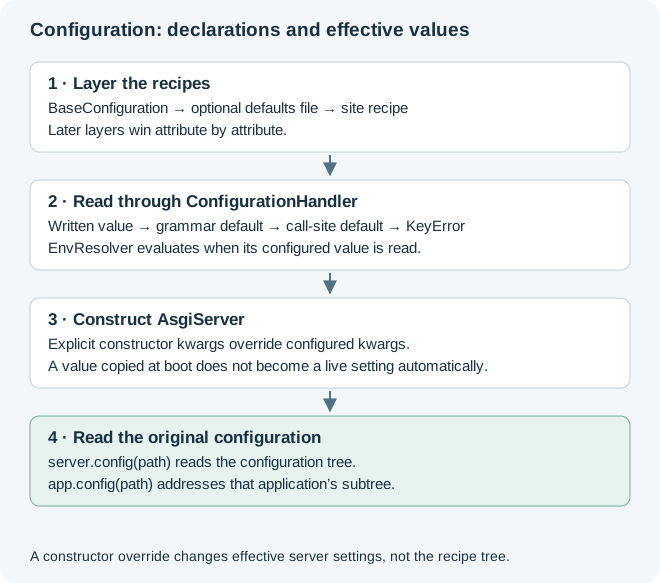
Recipe reads and effective constructor settings are separate: overriding port does not rewrite server.config.
The recipe
A recipe subclasses AsgiConfigBuilder and overrides main(self, root). main
opens the configuration root and delegates each section to its own method,
which takes the parent node:
from genro_asgi.config import AsgiConfigBuilder

from myshop.app import Application as Shop


class ServerConfiguration(AsgiConfigBuilder):
    def main(self, root):
        cfg = root.configuration()
        self.server_section(cfg)
        cfg.middleware(cors=True)
        self.applications_section(cfg)

    def server_section(self, cfg):
        """The listener and the session TTL."""
        cfg.server(host="127.0.0.1", port=8000).session(ttl=3600)

    def applications_section(self, cfg):
        """The shop answers the site root."""
        cfg.applications(default="shop").application(
            code="shop", mount="", app_class=Shop
        )
Sections are one method each because a section then stays short enough to read
at a glance, and because the method docstring is where the deployment
explains itself: the grammar documents what CAN be written, a recipe docstring
documents what THIS instance chose and why. main reads as a table of contents.
Every section is a singleton, so its label is its tag and every path below it is
stable and hand-writable: server.host, authentication.oidc.<code>,
applications.<code>.parameters.<name>.
Values that come from outside: resolvers in place
A value the recipe must not contain — a secret, a per-host address — is stored as a resolver where the value would go, and it resolves at read time, so the runtime always sees the environment’s current value:
from genro_bag.resolvers import EnvResolver


def server_section(self, cfg):
    """The port belongs to the host, not to the recipe."""
    cfg.server(
        host="127.0.0.1",
        port=EnvResolver("SHOP_PORT", dtype="L"),
    )
The environment gives strings, so a value that is not a string needs
dtype= — dtype="L" above delivers a real int for port. There are no
^pointer strings in this dialect: the resolver object itself sits in the
attribute.
For secrets this is not a convention but the signature: admin_password takes
node_value: BagResolver, so a literal is rejected at the recipe line —
cfg.authentication().admin_password(EnvResolver("SHOP_ADMIN_PASSWORD"))
— and a resolver that delivers nothing at boot is a ConfigError, never a
passwordless SUPERADMIN.
Handing it to the server
AsgiServer(config=...) accepts four sources: a recipe class, a recipe
instance, a path to a config.py, or a ready ConfigurationHandler.
server = AsgiServer(config=ServerConfiguration)          # class
server = AsgiServer(config="/srv/shop/config.py")        # path
An explicit constructor kwarg wins over the configured value, wholesale per kwarg — the server computes nothing, it just prefers what you passed:
tuned = AsgiServer(config=ServerConfiguration, port=9000)
tuned.config("server.port")   # 8000 — the recipe still says what it said
tuned.config_port             # 9000 — what the server will bind
Layered defaults: BaseConfiguration and default_config
A site recipe never stands alone: the handler the server builds layers it over
parent recipes, lowest first, the site always last and winning (attribute by
attribute — a section that sets only port inherits everything else).
BaseConfiguration— the package’s shipped defaults, as a recipe. It declares the default storage layout (the singlesite:mount on the deployment directory) and exposes one hook per concern, so the minimal deployment is a subclass that sets what deviates:from genro_bag.resolvers import EnvResolver from genro_asgi import BaseConfiguration class Site(BaseConfiguration): storage_key = EnvResolver("STORAGE_KEY") # everything else inherited
The defaults file — a recipe the deployment host owns, layered between the package defaults and the site. Where it comes from is declared by the site recipe itself, through the
default_configclass attribute:default_configmeaning
unset (or
True)<home>/config.py, layered only when the file existsFalseno defaults file — the site sits straight on
BaseConfigurationa path
THAT file; a missing path is a loud
ConfigErrorat bootThe site recipe — always the top layer.
<home> is genro-asgi’s own directory — the registry, the pids, the defaults
file — and resolves as: explicit base_dir argument → the GENRO_ASGI_HOME
environment variable → ~/.genroasgi. The variable is how a container or a
virtualenv gets an isolated home (GENRO_ASGI_HOME=$VIRTUAL_ENV/.genroasgi);
nothing is inferred from the environment beyond it. The test suite pins it to
an empty per-test directory, so tests never read a developer’s real home.
Reading it back
The handler is server.config and it is callable by path:
server.config("server.host")                  # '127.0.0.1'
server.config("server.session.ttl")           # 3600
server.config("openapi.title", default="Shop API")
Each read walks four layers, in order:
the written value — what the recipe put there;
the element’s signature default —
page_size: int = 20answers 20 even when the recipe never wrote it;the call-site
default=— your fallback for a value nobody declared;a noisy
KeyErrornaming the path and saying which layers were empty:
missing config value 'server.nonexistent' (source: 'configuration.server?nonexistent'):
not written by the recipe, no signature default, no call-site default
A server built bare — no config= — has server.config is None.
What an application reads
An application holds an address in the tree, never a slice of it:
app.config(path) prefixes applications.<code>. and delegates to the same
door, so the two reads below are the same read.
class Themed(RoutedApplication):
    mount = ""

    @route()
    def theme(self) -> dict[str, str]:
        return {"theme": self.config("parameters.theme", default="light")}
site.config("parameters.theme")                          # 'dark'
server.config("applications.site.parameters.theme")      # 'dark'
Every application inherits one element, parameters, whose kwargs are free —
enough for a handful of options. An app with a real vocabulary of its own
declares a grammar, and application(app_class=...) mounts it for that
node’s children: the site dialect never validates an app’s internal words, the
app itself declares them.
from genro_asgi.application import ApplicationGrammar
from genro_builders.builder import element


class ShopGrammar(ApplicationGrammar):
    """The shop's own vocabulary, on top of the inherited ``parameters``."""

    @element(node_label="catalog")
    def catalog(self, title: str = None, page_size: int = 20) -> None:
        """Read back as ``applications.<code>.catalog.<attr>``."""


class Shop(RoutedApplication):
    grammar = ShopGrammar
The attributes of the application envelope itself (code, mount,
app_class, plus the app’s constructor kwargs) belong to the site grammar; only
the children live in the mounted one. An undeclared child is a boot error.
The sections
One line each; the deep dives live in their own guides.
server—host,port,external_url(the PUBLIC address, not the listener),max_threads,shutdown_timeout_seconds(default 5.0), pluswebsocket(origins,max_concurrent),session(itsttl) andtasks(see Background tasks).middleware— one{name: bool | dict}switch per middleware; a dict enables it and becomes its options (see Middleware).authentication— the whole identity surface in one section:admin_password, theusers/tokensstores, theloginlockout policy, theoidcproviders and the headercredentials. The grammar of each is in Authentication.storage— the mount point of genro-storage’s own grammar:storage_keyplus one child per mount, written in genro-storage’s words (see The storage section).applications— the app collection keyed bycode, with the optionaldefaultnaming who/redirects to.databases— one descriptor per database:db_classand its connection kwargs; the core never imports a driver.plugins— the router plugins armed on every routed app.openapi— accepted by the grammar but not consumed by the core. Set schema title, version and description with theOpenApiApplicationopenapi_infoclass attribute instead (see OpenAPI & Swagger). The SPA pool belongs to an application’sorchestrationsubtree; it is not a root section. See The pool subtree and Multiworker SPA.
The storage section
The server’s storage is a genro_storage.StorageManager, and this dialect
declares no storage vocabulary of its own: storage is a mount point for
genro-storage’s grammar. app=StorageManager carries that grammar (required —
the subbuilder reference reads the call site, so it cannot be defaulted), and
the mounts hang directly under the section, one element per protocol, the tag
being the protocol:
from genro_bag.resolvers import EnvResolver
from genro_storage import StorageManager


def storage_section(self, cfg):
    """One local tree for the site, one bucket for uploads."""
    s = cfg.storage(app=StorageManager, storage_key=EnvResolver("SHOP_STORAGE_KEY"))
    s.local(name="site", base_path="/srv/shop")
    s.s3(name="uploads", bucket="shop-media", default_encrypted="shopspa")
Omit the section entirely and the server builds its default manager: the single
site: mount on the deployment directory (the process cwd). The mount must
already exist — a recipe naming a missing directory is a boot error.
site: is where the server’s own state lands, all in one tree: site:users and
site:api_keys (written encrypted=True), site:sessions, site:tasks and
site:batches (plain). Encryption is declared per write, not per mount, and
what lands on disk is self-describing — an envelope whose first line starts
#GNRE1: — so reads declare nothing.
Outside a recipe the same three shapes reach the constructor as storage=:
None for the default site: mount, a ready StorageManager to adopt, or
genro-storage’s own list[dict] of mount configurations.
The pool subtree: orchestration, its commander and its groups
A site whose pages live in worker processes declares the whole thing under ONE
node of the front that owns it: orchestration. It is not a section of the site
dialect — it belongs to the SPA application’s own grammar — so it is written on
the application element, never on cfg:
applications → application → orchestration → commander → groups → group
Three rungs carry words: orchestration (the profiles and the control surface),
the commander (the vertex: one per front) and one group per family of
workers. Nothing in it says how many processes there are: the group brings
its reception into being at boot, then grows on demand and shrinks when capacity
is spare, so the count is something you read in the log, never something you set.
from genro_asgi_multiworker_spa.spa_app import SpaApplication


def applications_section(self, cfg):
    """The front, its orchestration, one vertex, two groups on two interpreters."""
    front = cfg.applications().application(
        app_class=SpaApplication, code="shop", mount="",
    )
    orchestration = front.orchestration(
        control_enabled=False,  # runtime profile operations require one group
    )
    commander = orchestration.commander(
        frozen_users_path="/var/lib/shop/frozen_users",
        instance_dir="/var/run/shop",
        orchestration_log_path="/var/log/shop/orchestration.log",
        memory_max_percent=80.0,             # what this server may hold of the machine
        machine_memory_alarm_percent=90.0,   # past this, nothing grows
        user_expiry_hours=720.0,             # a frozen person is kept a month
        guest_expiry_hours=24.0,             # a frozen browser, a day
    )
    groups = commander.groups()
    groups.group(name="stable", worker_memory_admission_percent=80.0,
                 user_idle_freeze_minutes=60.0,
                 cpu_admission_reopen_percent=30.0,   # below this a worker admits again
                 cpu_admission_close_percent=50.0,         # above this it stops taking new users
                 cpu_offload_percent=75.0,      # above this it cedes one user per beat
                 cpu_heating_seconds=1.0,       # the temperature filter, going up
                 cpu_cooling_seconds=5.0,       # and going down: slower on purpose
                 entry_module="genro_asgi_multiworker_spa.orchestration.worker_entry",
                 worker_class="myshop.app:ShopWorker",
                 worker_kwargs={"site_path": "/srv/shop"})
    groups.group(name="canary", executable="/srv/shop/.venvs/next/bin/python",
                 entry_module="genro_asgi_multiworker_spa.orchestration.worker_entry",
                 worker_class="myshop.app:ShopWorker")
Named profiles, environment overrides and runtime apply/reload/status
currently require exactly one group. The two-group template above uses recipe
settings directly, without a named profile or environment overrides.
The node is required, and so is the commander under it. A spa front IS its
pool: one declared without orchestration would answer every request with a
raise, so the server does not start and the recipe is asked for the node. Wanting
no pool means declaring no spa front, not declaring one and leaving it hollow.
The same holds one rung down: the node MUST carry a commander, because a
profile and a control surface with no pool to act on address nothing. Either way
the boot fails loudly instead of starting half-configured.
The profiles and the control surface are the node’s own. profiles_path is
the folder the stored profiles are read from — the same one the _sysop archive
writes — and profile_name the profile the boot must find and put in force:
named without a folder, or named and not there, or there and invalid, and the
server does not start. control_enabled opens apply, reload and status
under the front’s _orchestration root; off, that root is never claimed and the
path belongs to the hosted site. The effective configuration of the one group is
composed as defaults ⊕ recipe ⊕ profile ⊕ env — env_settings being a plain
constructor kwarg of the application, a dict the Python recipe builds out of the
environment, and no word of any grammar.
The two paths are the installation’s, so they are declared once, on
commander: frozen_users_path (the freezer — one root for the whole machine,
because the vertex reads back what a worker wrote there) and instance_dir (the
sockets). Every group is handed both.
Group memory percentages
The memory is a cascade of percentages, and only the machine is measured in
bytes. memory_max_percent on commander is the server’s concession on the
machine; memory_max_percent on a group is that group’s share of the
concession; worker_memory_max_percent is what ONE of its workers may hold of
the group’s share. The same word on each rung is deliberate — it always means
“my share of the rung above”. The machine’s total is read off the platform
itself, so the cascade is always anchored; a machine that does not say how much
of it is IN USE (a /proc/meminfo capability) simply alarms nobody.
The memory keys are a veto, never a choice. worker_memory_admission_percent
(default 80) is the share of its ceiling past which a worker takes no new user,
whatever its CPU says; restart_occupancy_max_percent (default 95) is where a
process is replaced rather than kept. Neither picks a worker: the CPU does.
The CPU picks the worker. A newcomer goes to the hottest CPU-open worker
that admits him — the group consolidates while a worker still has room under the
close threshold — and a worker that admitted somebody less than
worker_admission_interval_seconds ago (default 1) is skipped, so its load shows
in the temperature before the next one lands. When every open worker is in its
window the hottest that admits takes him anyway: the interval orders the walk,
it refuses nobody and births nobody. Nobody estimates what a user will cost: the
gate is the CPU admission, the heads and the memory veto.
CPU admission thresholds
The CPU keys are the soft admission, and its brake. cpu_admission_close_percent
(experimental, off when omitted) is the smoothed CPU above which a worker stops
taking NEW users; it reopens below cpu_admission_reopen_percent, and between the two
it keeps the state it had — the band is hysteresis. A CPU sample never forks a
process: capacity is created by a concrete arrival that no open worker can
admit. cpu_retirement_quiet_seconds (default 60) is the other half: how long
the CPU must stay SILENT — nobody blocked, nobody reopened — before the closure
judge resumes. It is the quiet of the whole GROUP, not the age of one worker
(that is worker_min_life_seconds), and every CPU event restarts it whole.
Without it, closing the emptiest worker while demand still stands hands its
users back to the hot one, which regrows seconds later. With the CPU policy off
the brake does not exist at all.
cpu_heating_seconds and cpu_cooling_seconds
The temperature the CPU keys read is filtered. The commander samples each
worker’s CPU every 100 ms; a saturated process reads 0% or 100% on such a short
window, so no judge reads the raw sample. cpu_heating_seconds (default 1) and
cpu_cooling_seconds (default 5) are the time constants of a first-order filter
the sample goes through: the temperature moves towards the sample by
1 - exp(-dt/tau), with the shorter constant when the sample is hotter and the
longer one when it is colder. A worker heats up in about a second and needs
several seconds of real silence to reopen, so a user it just ceded does not come
back on the next request. The raw sample stays visible in the pool census as
cpu_temperature_sample_percent, beside the filtered cpu_temperature_percent.
cpu_close_percent retirement
cpu_close_percent is where the pool shrinks. Past the CPU quiet, the coldest
worker is closed when its temperature, shared by the survivors, keeps every one
of them under this key (unset, the reopen threshold itself; set while the CPU
admission is on, never above cpu_admission_reopen_percent),
and its memory, shared the same way, keeps every survivor under
worker_memory_admission_percent. A worker with no temperature yet suspends the
judgment. Its users go to the freezer and wake where their next request lands.
cpu_offload_percent user selection
cpu_offload_percent is what makes a hot worker slim down. Closing the
admission protects the workers to come; it does nothing for the users already
placed on a process that is burning CPU. This key (nullable, None by default —
omitted, no user is ever offloaded) is the smoothed CPU above which the group
takes at most ONE user per heartbeat off that worker and puts him in the
freezer. It requires cpu_admission_close_percent, and the thresholds are ordered:
cpu_admission_reopen_percent < cpu_admission_close_percent < cpu_offload_percent <= 100
An offload declared without the admission key, or out of order, is refused at boot — the ordering is not decoration: the worker must already be closed to new users, or the ordinary placement could put the offloaded user straight back on it.
WHO leaves is judged against the interval itself, so there is no absolute
threshold to tune. Over the users with activity in the last interval, with S
their summed recent service time and N their count, a material contributor
is one holding at least half the fair share (s >= S/(2N)) or having a request
in flight. Users that are idle or whose activity is negligible against the
window are never candidates — the idle ones belong to user_idle_freeze_minutes
instead. Among the material contributors, the one ceded is the least busy of
those with NO request in flight: a user mid-call is never transferred. His next
request goes through the ordinary placement, which skips CPU-closed workers and
creates capacity when no open one can take him. CPU pressure never restarts a
process — that remains memory’s business alone
(restart_occupancy_max_percent).
Two standing conditions are recorded instead of acted on: when only one material
contributor is left the worker is de facto dedicated to him and the group logs
single_user_overload rather than moving him; when every material contributor
has requests in flight the cession is postponed to the next heartbeat and logged
as cpu_offload_deferred_pending_calls.
What each user costs is measured, and it is observation only. Every worker
keeps three cumulative counters per user — served_call_count and
service_seconds, both stamped whatever the request did (a call that failed or
ran long is exactly the one worth counting), plus pending_call_count, the
requests open right now — and puts them in its photo. The group derives from two
consecutive photos the recent deltas the offload judgment reads. These numbers
serve observability and the pool’s decisions; they are not part of a user’s
frozen application state, so a user parked in the freezer and woken elsewhere
carries his store and his connections, never his counters.
The ages are the vertex’s. user_expiry_hours / guest_expiry_hours on
commander are how long a FROZEN user is kept before the machine forgets him
whole — the vertex holds them because a frozen user lives in no process, and a
group could not notice him. user_idle_freeze_minutes (group) is the silence
past which a worker parks a user in the freezer: his state survives on disk, and
his next request brings him back wherever the pool then puts him.
The identity of the child is the group’s too: entry_module (what python -m runs), executable (its interpreter — two groups on two venvs is how two
versions of a site serve side by side), worker_class (the module:Class the
child loads), main_threadpool_size / aux_threadpool_size, and
worker_kwargs, the grammar that class is built with. The group’s name and its
user_idle_freeze_minutes are added to those kwargs on the way down, so you
write each policy once, on the rung it belongs to.
What is NOT a key. No worker count and no maximum. No policy for the freezer’s disk: under a tenth of it free the orchestration log says so and the server asks its environment for more. And no clocks — the beat, the patience of a departure and the cadences are module constants, because an installation tunes policies, not timings.
Orchestration decision journal
The account of what the pool does is orchestration_log_path (with
orchestration_log_max_bytes and orchestration_log_backup_count): one row per
order, saying who decided, what, on whom, with which numbers in front of them and
how it ended.
decided_by=std order=start_worker subject=std_0002 numbers={'workers': 2} outcome=None
decided_by=std order=close_worker subject=std_0002 numbers={'occupancy_percent': 7.0, 'workers': 2} outcome=None
decided_by=std order=drop_worker subject=std_0002 numbers=None outcome=quitted
decided_by=vertex order=drop_user subject=mario numbers={'had_state': False} outcome=process_aborted
Omit the path and the rows stay on the genro_asgi.orchestration.orders logger,
which is what a test wants.
Beside that human log the commander writes a machine-readable decision
journal, <stem>.decisions.jsonl: one JSON row per judgment, carrying a stable
reason code and the numbers the judge had in front of it. The offload adds its
own codes, and reading them in order is enough to reconstruct why a user moved
or why none did:
Reason code |
What it says |
|---|---|
|
this worker is past |
|
who is leaving, with his recent deltas |
|
the freeze confirmed; he is in the deposit |
|
the ordered departure did not happen; he stays where he was |
|
nobody on that worker contributes materially |
|
every material contributor has a request in flight; the next heartbeat tries again |
|
one material contributor left; the worker is dedicated to him and nobody is moved |
Each row carries the worker’s CPU, the window’s summed service time and the number of active users, the computed material threshold, and how many contributors were material and cedible. The two standing conditions are written once when they begin, not at every heartbeat.
The pool snippet above is an installation template: it needs your ShopWorker,
existing storage paths and interpreters. It is not
a standalone hello-world. The core recipe below has different prerequisites.
A complete recipe
Server, middleware, an environment secret, and one application with a grammar of
its own. Use this self-contained block as your config.py; do not concatenate
the earlier examples, which declare alternative recipe classes. The storage
directory and environment prerequisites are described below.
from genro_asgi import AsgiServer, RoutedApplication
from genro_asgi.application import ApplicationGrammar
from genro_asgi.config import AsgiConfigBuilder
from genro_bag.resolvers import EnvResolver
from genro_builders.builder import element
from genro_routes import route
from genro_storage import StorageManager


class ShopGrammar(ApplicationGrammar):
    @element(node_label="catalog")
    def catalog(self, title: str = None, page_size: int = 20) -> None:
        """The catalog title and page size."""


class Shop(RoutedApplication):
    grammar = ShopGrammar

    @route()
    def index(self) -> dict:
        return {"catalog": self.config("catalog.title")}


class ServerConfiguration(AsgiConfigBuilder):
    def main(self, root):
        cfg = root.configuration()
        self.server_section(cfg)
        cfg.middleware(cors=True, logging=True)
        self.authentication_section(cfg)
        self.storage_section(cfg)
        self.applications_section(cfg)

    def server_section(self, cfg):
        """Bind locally; the public address is what a third party is handed."""
        cfg.server(
            host="127.0.0.1",
            port=EnvResolver("SHOP_PORT", dtype="L"),
            external_url="https://shop.example.com",
        ).session(ttl=3600)

    def storage_section(self, cfg):
        """The site tree, and the key that unlocks what is encrypted in it."""
        cfg.storage(
            app=StorageManager,
            storage_key=EnvResolver("SHOP_STORAGE_KEY"),
        ).local(name="site", base_path="/srv/shop")

    def authentication_section(self, cfg):
        """The bootstrap secret comes from the environment, never from here."""
        cfg.authentication().admin_password(EnvResolver("SHOP_ADMIN_PASSWORD"))

    def applications_section(self, cfg):
        """One app on the site root, declaring its own catalog block."""
        app = cfg.applications(default="shop").application(
            code="shop", mount="", app_class=Shop
        )
        app.parameters(currency="EUR")
        app.catalog(title="Outlet")
How to verify it
First create the storage anchors — the recipe names /srv/shop, and a local
mount whose directory does not exist is a boot error (the rule stated in the
storage section above), so the recipe fails before any read without this step:
mkdir -p /srv/shop
Then, with SHOP_PORT=8123, SHOP_STORAGE_KEY (a Fernet key) and
SHOP_ADMIN_PASSWORD (the bootstrap secret) exported, build the server and
read it back through both doors:
>>> server = AsgiServer(config=ServerConfiguration)
>>> server.config("server.host")
'127.0.0.1'
>>> server.config("server.port")            # resolved, dtype="L" → int
8123
>>> server.config("server.session.ttl")
3600
>>> server.config("middleware.cors")
True
>>> server.config("applications.shop.catalog.page_size")   # signature default
20
>>> shop = server.applications["shop"]
>>> shop.config("parameters.currency")
'EUR'
>>> shop.config("catalog.title")
'Outlet'
>>> shop.config("catalog.locale", default="it")            # call-site default
'it'
Gotchas
A secret is a resolver, not a string.
admin_passwordrefuses a literal in the signature; the other secret-bearing attributes (storage_key,client_secret,password,token,secret) accept one, and should not get it — a recipe is code you commit.dtype=or you get a string.port=EnvResolver("SHOP_PORT")withoutdtype="L"hands the server"8123".admin_passwordneeds a key, not just somewhere to write. The bootstrap admin lands in the identity store undersite:users, which writesencrypted=True, so a recipe with anadmin_passwordand nostorage_keyfails at the write with genro-storage’sCannot encrypt for encryption domain '': it requires installed key material.storage_keylives onstorage, not onserver. It is meaningless without the mounts it unlocks; a recipe still passing it tocfg.server(...)is a boot error naming the attribute.mount=""is the site root, and it is not the same asmount=None. Omitted, the mount defaults to thecode; empty, the app answers/and every unclaimed path.applications.defaultelects nobody. It names who/redirects to (307) when no application claims the root; naming a code that does not exist is a boot error.The recipe is read, not frozen. A resolver resolves on every read, so changing the environment changes what the runtime sees — a configured value that looks stale usually means it was copied into a local variable at boot.
One recipe class per
config.py. The handler’s contract is “exactly oneConfigBuildersubclass in that file”; a second one is an error naming both.